

Filming, interviewing, and other professional activities may require a specific visa, work authorization, or filming approval, depending on the production's type and nature. A tourist visa does not permit professional filming.
Foreign crew on short-term filming assignments—especially for documentaries, news, and factual TV shows — will normally need a J-2 visa. Confirm the correct category with the Chinese embassy or consulate and the local production partner when planning a shoot in China.
Provide your local fixer with the synopsis, script, schedule, crew info, and equipment list well in advance. Do not film on commercial or private property, at religious sites, public facilities, or restricted areas without proper authorization and location permission.
Do not film military, police, or security facilities; border-control areas; transportation hubs (including train/bus/metro stations and airports); banks; or other government facilities without prior authorization.
Filming is also prohibited on public transport, including high-speed trains, conventional trains, subways, and aircraft. Additionally, do not film security checkpoints, restricted entrances, or official personnel unless cleared in advance by your fixer.
Electric bikes and scooters are everywhere in China and often move silently and quickly—including on sidewalks and through pedestrian areas. Check both directions before crossing, use designated crossings, and stay clear of cycle lanes. Always wear a seat belt in vehicles.
China uses 220 V / 50 Hz power. Consider renting production equipment locally, which is widely available and often more convenient and cost-effective.
If bringing professional equipment from overseas for temporary use, obtain an ATA Carnet before arrival. Please note that all ATA Carnets need to be registered in the Chinese Customs database on the CCOIC website. YUNIQUE PICTURES can register your ATA Carnet online before your arrival, saving you all the hassle at customs.
Drone operations are strictly regulated under the Civil Aviation Law of the PRC. Professional aerial filming in China requires a CAAC-licensed drone pilot and drones registered on the official UOM platform.
Please note that the entire administrative area of Beijing is designated as controlled airspace; drone flights are generally prohibited without approval. Furthermore, drones brought from other cities must be registered in advance; unregistered drones will not be permitted to enter Beijing.
Greet with a smile and "Ni Hao." A light handshake is appropriate in professional settings—follow your local fixer's lead. Always greet elders or senior people first.
- Present business cards, gifts, or documents with both hands.
- When asking strangers for help, avoid exaggerated gestures that may cause cultural misunderstandings.
- Avoid jokes about war, politics, religion, poverty, or ethnic differences.
- Keep your voice low in public; and do not play music or videos out loud without headphones in public.
- Do not sit or lie on the ground, or sit on tables, railings, or other public fixtures.
- Avoid kneeling or making culturally inappropriate gestures in public.
- Avoid removing your shoes in public places, and never point your feet at others, as this is considered disrespectful.
- Remove your hat when entering temples, Buddhist halls, or other religious spaces.
Smoking—including e-cigarettes—is banned on all public transport and in most indoor areas.
Locals may offer a cigarette as a friendly gesture; they expect nothing in return. Accept with both hands and say "Xiexie," or politely decline with a smile.
Mobile payment via Alipay or WeChat Pay is ubiquitous. International cards are not accepted everywhere, so set up a local mobile payment option before arrival. Carry some CNY cash as backup, especially in smaller towns, rural areas, and local markets.
Respect agreed working hours, rest days, and public holidays.
Please note that working on Chinese public holidays incurs premium pay. Specifically, working on the actual statutory holiday dates requires triple pay (300%). Working on adjusted rest days requires double pay (200%).
Always confirm crew availability and budget for these surcharges before locking the schedule.
Chinese meals are typically shared. Hosts may serve food or invite guests to eat first. Wait for the host or most senior person to begin, use shared serving utensils when provided, and politely acknowledge offers of food or drink. Follow the host's lead for toasting and other dining customs.
Chinese cuisine commonly uses lard, soybean oil, and other allergens. Inform the fixer and catering staff of any allergies or dietary restrictions in advance, and always confirm ingredients with restaurants and caterers.
Google services (Gmail, Maps, Drive), YouTube, Instagram, Facebook, X, and WhatsApp may not be accessible in mainland China. Set up your communication and file-sharing tools before arrival. Alternatively, an international SIM card with roaming enabled may allow continued access to these services.
WeChat is essential for working with local teams—for registration help, visit their official website.
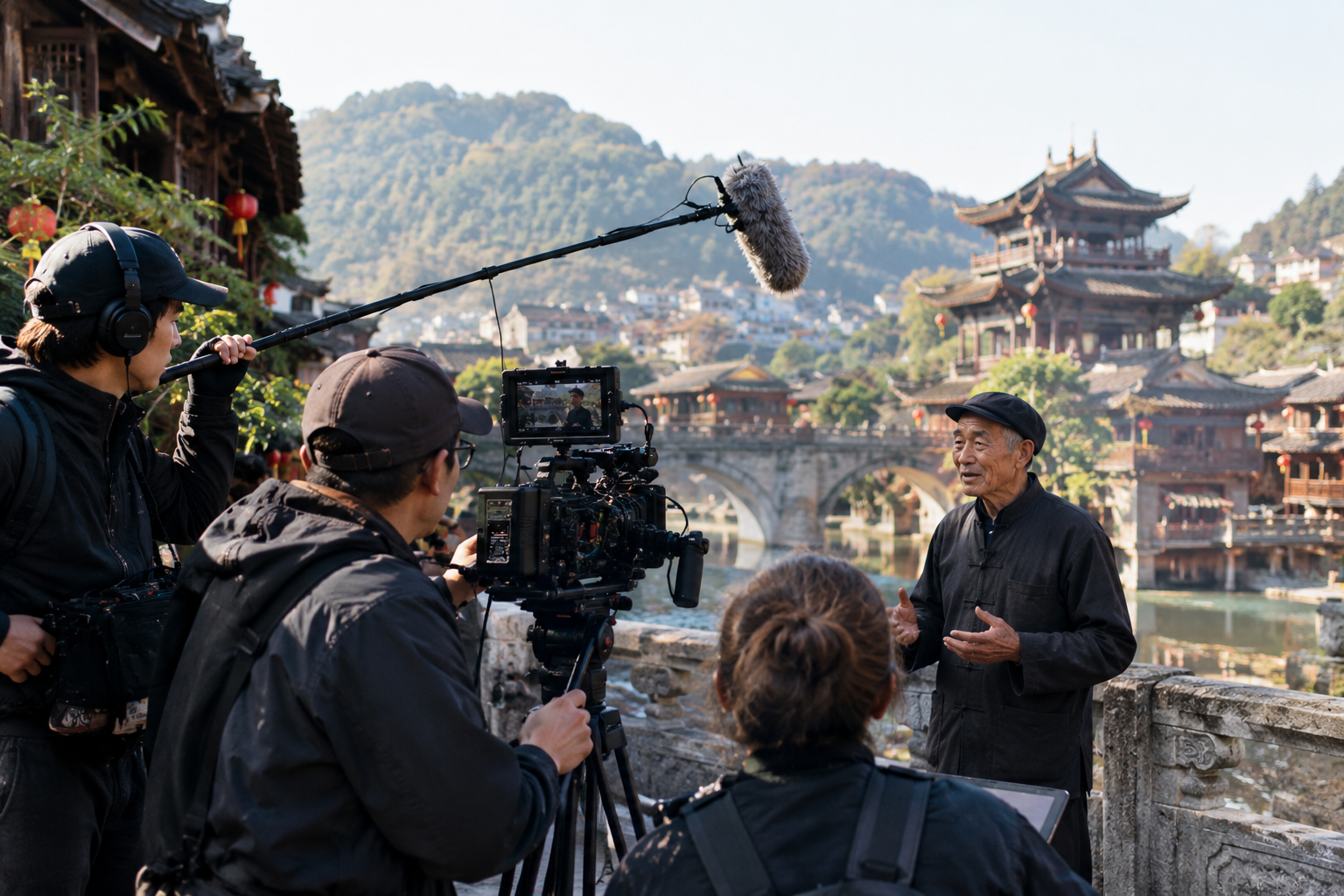
Ask before filming close-ups. Explain who the crew is, what will be filmed, and how the footage will be used. Obtain appropriate permission when filming children or vulnerable people, and never pressure anyone to participate.
Coordinate access with local representatives and the fixer, especially when filming ethnic-minority communities. Respect clothing, rituals, and private spaces. Avoid treating communities as props or staging misleading re-enactments.
Agree on any payments, donations, credits, or footage copies before filming. Avoid unnecessarily filming passports, IDs, phone numbers, addresses, documents, screens, or other confidential information.
· Nǐ hǎo 你好。 -- Hello.
· Xièxie 谢谢。 -- Thank you.
· Bù hǎoyìsi 不好意思 / Duìbuqǐ 对不起 -- Excuse me. / I'm sorry.
· Wǒmen kěyǐ zài zhèlǐ pāishè ma? 我们可以在这里拍摄吗?-- May we film here?